WITH RICO DUENAS
RICO DUENAS
“Old things can be beautiful. Age brings beauty. ”
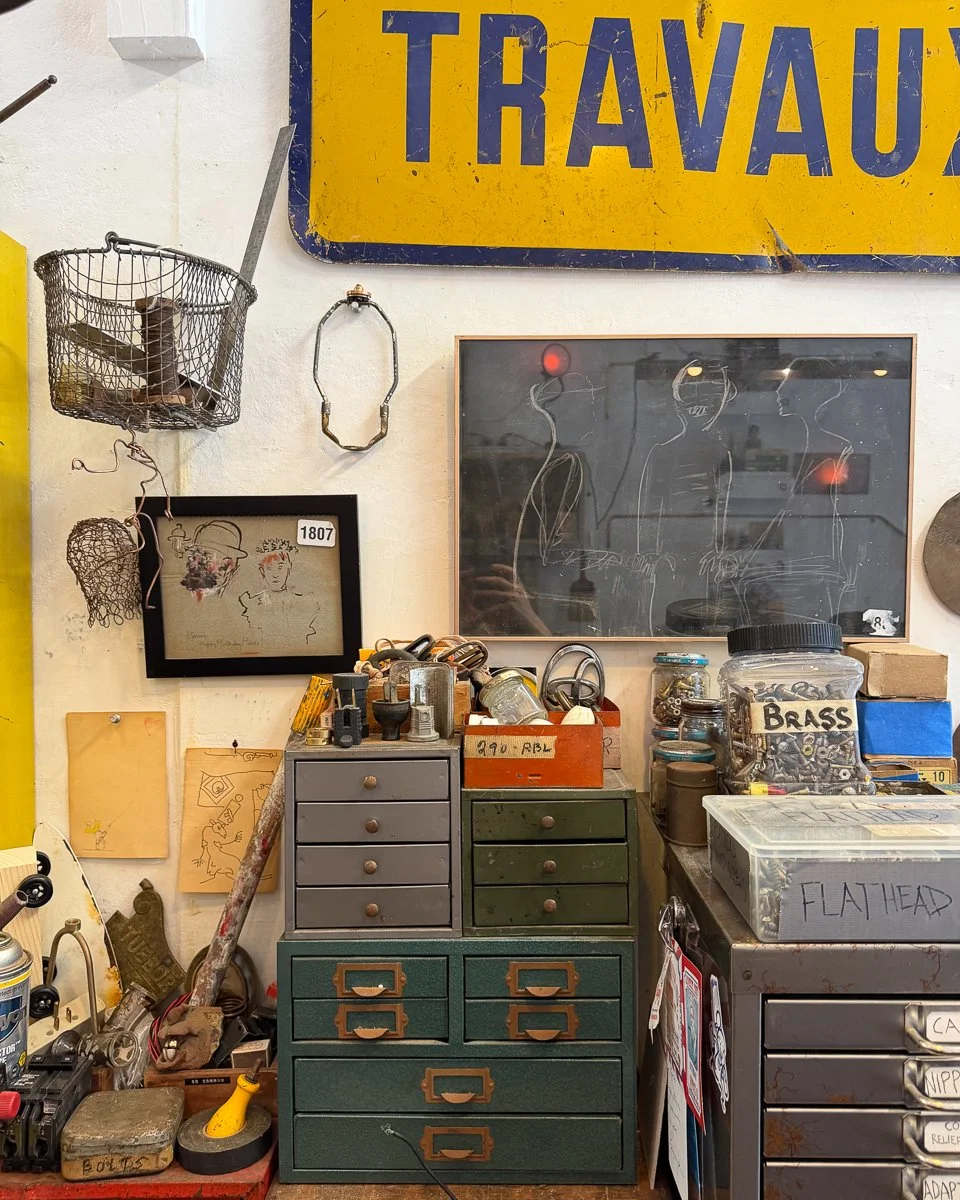
San Francisco–based artist and union electrician Rico Duenas builds a singular creative practice at the intersection of craft, salvage, and light. Born and raised in the city, Duenas grew up immersed in a family environment rich with art and hands-on making. When he was very young, he spend summers in Cape Cod and New York at his grandfather’s studios who was a sculptor. In the Bay Area, he would frequent flea markets with his father and family, and spend years tinkering in garages. Those formative experiences inform a body of work that celebrates the tactile history of found objects, particularly metal and salvaged materials, transforming them into sculptural lamps and light works that blur the line between functional object and poetic form. In his everyday life, Duenas works as a union electrician, a role that gives him not only technical fluency with wiring and installation but also the financial stability to pursue creative experimentation without the constraints of commercial pressure.
In recent years, Duenas has emerged as a distinctive voice in the Bay Area art scene through a series of notable exhibitions that explore illumination as both concept and material. His solo show It’s a Lamp! at 500 Capp Street Foundation in early 2026 continued a long-running dialogue with the legacy of artist David Ireland, presenting never-before-seen lighting sculptures that engage directly with the architecture and histories of the David Ireland House, where light becomes a lived and ambient presence. This project followed his 2021 installation Light Repair, also at 500 Capp Street, where his handcrafted lamps and a public lamp-repair workshop offered visitors a poetic encounter with everyday materials and craft. Duenas’s work has also appeared in curated gallery contexts such as Light Work at Park Life in San Francisco, showcasing his ability to combine playfulness, technical know-how, and an innate sensitivity to the patina of objects found in flea markets and scrapyards across the city.
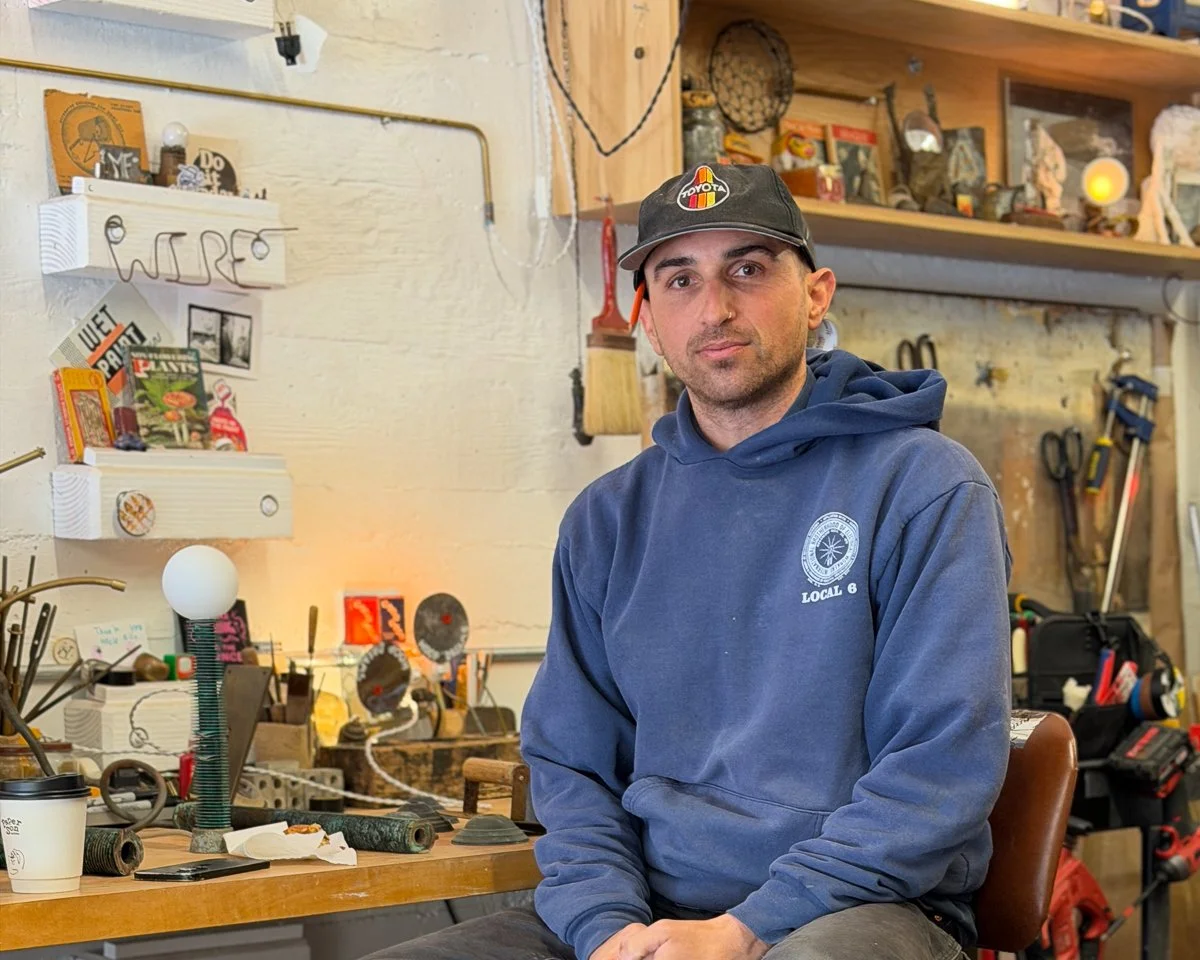
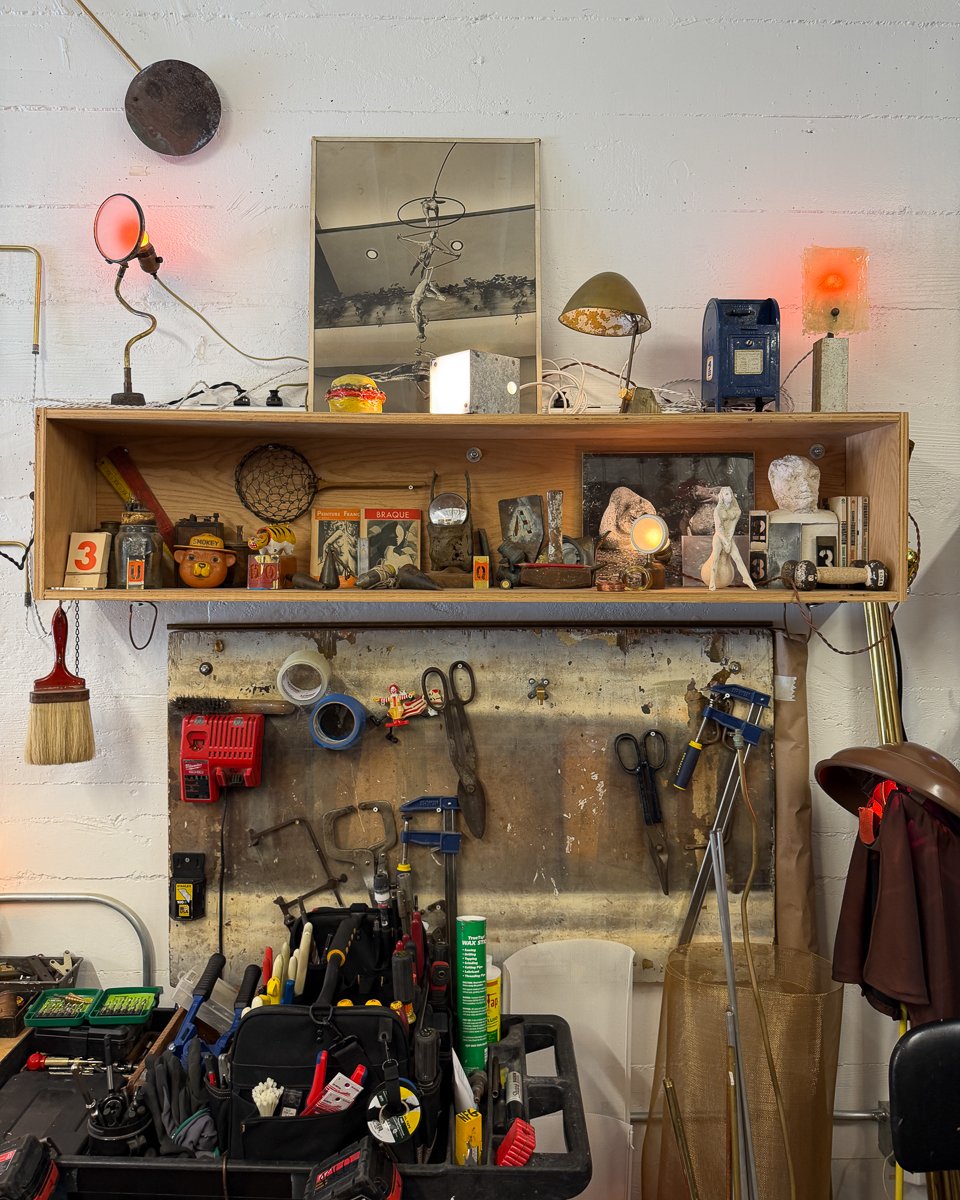
Rico Duenas in his studio. Photo: Christine Lin
CL: What early experiences shaped you as a creative person?
RD: I didn’t go to art school. I did a year at Chico, undeclared, then city college where I studied printmaking. My grandfather was a sculptor, so I grew up around art. He made several of the pieces in my parents’ house. My mom was into theater. Creativity—drawing, Play-Doh, making things—was emphasized at home. It was just part of life.
My grandfather had places in Cape Cod and New York City, and I spent summers in his studio watching him work. He passed away when I was eight, but my parents’ house is filled with art. It wasn’t treated as precious—we could touch and handle things. That environment was unique.
My dad also owned a junk store in San Francisco called Earthquake City. So flea markets (our church), dumpster diving, fixing old furniture—that was normal. We didn’t buy new things. Sustainability wasn’t a trend; it was necessity with four kids. All of that combined shaped me.
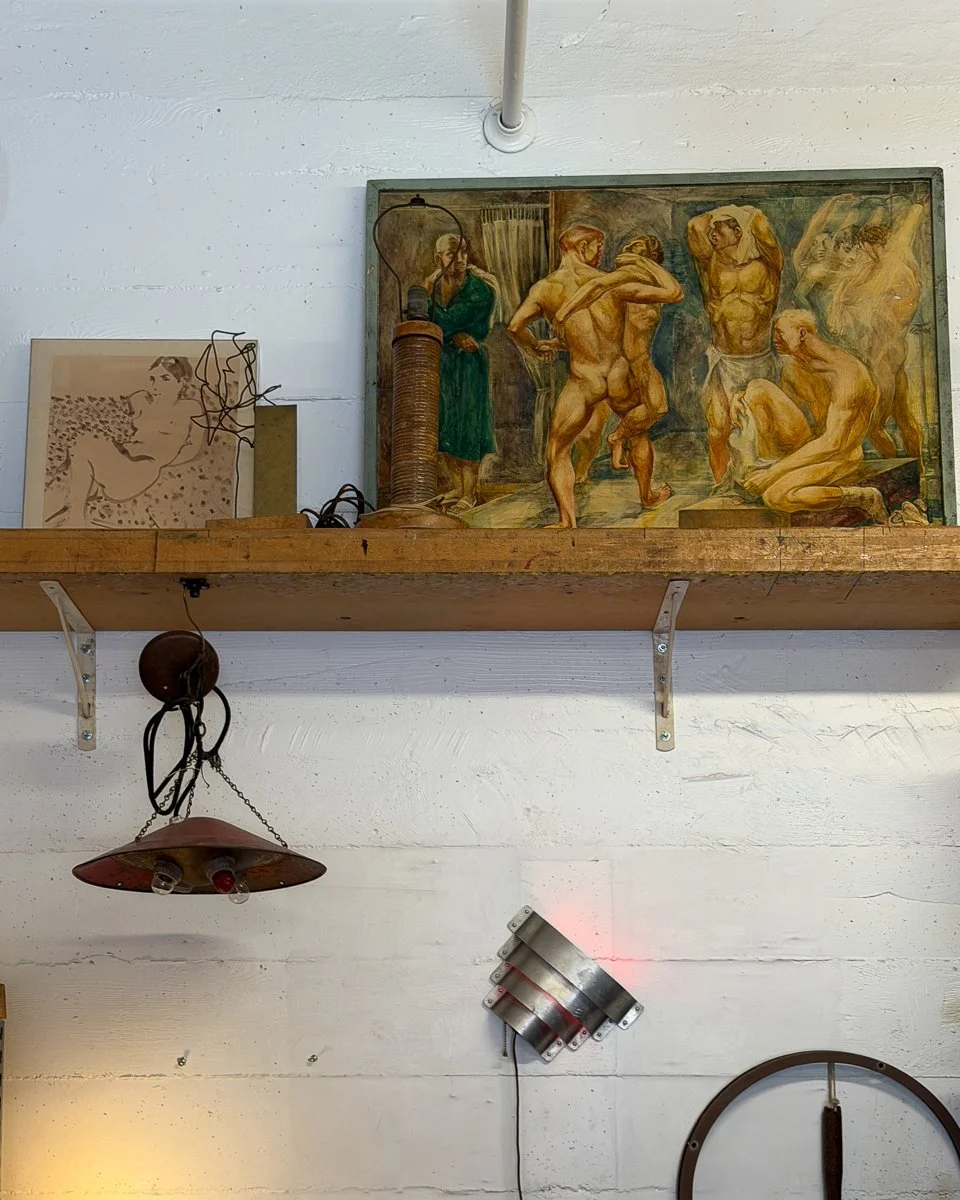
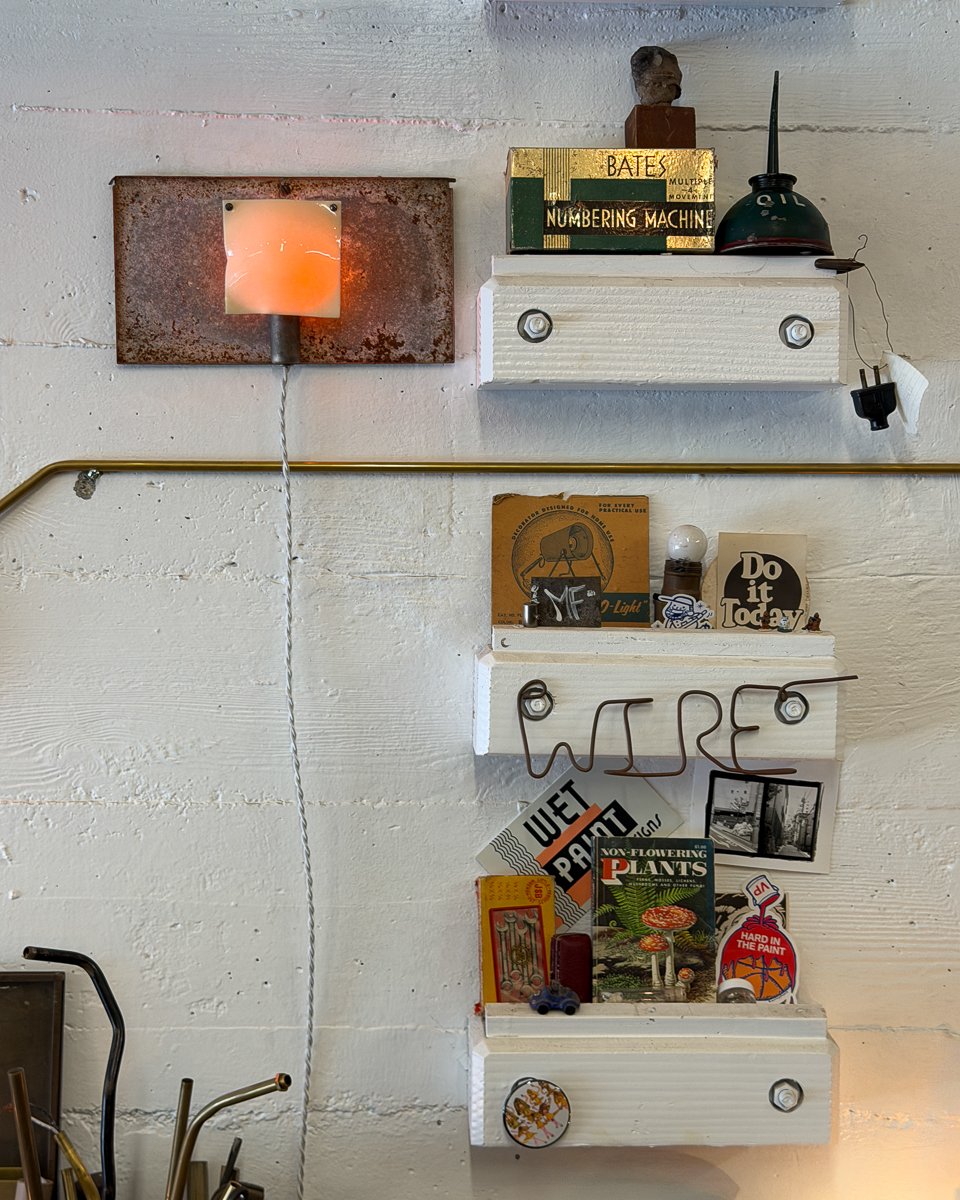
Artworks by Duenas’ sculptor grandfather sit high on a shelf in his studio. Photo: Christine Lin
CL: What part of your personal history do you feel most informs your work today?
RD: I have been making lights for about 20 years. I worked with local artist Kevin Randolph, who used to sell at the flea market and make lights. When I came back from my year at Chico, I was looking for something to do. My family went to the flea market every Sunday, so I ran into Kevin. He invited me to his shop, and it felt like the perfect marriage of two things I love: making things and the flea market. I fell in love with it immediately.
That eventually led me to the electricians union. I was tired of working multiple coffee shop jobs and barely making rent. My dad suggested I apply to the union, and I just fell into it. It wasn’t planned, but it turned out to be another perfect marriage. Now I can make something and install it, which is pretty cool.
CL: What do you hope people feel or understand when they experience your work?
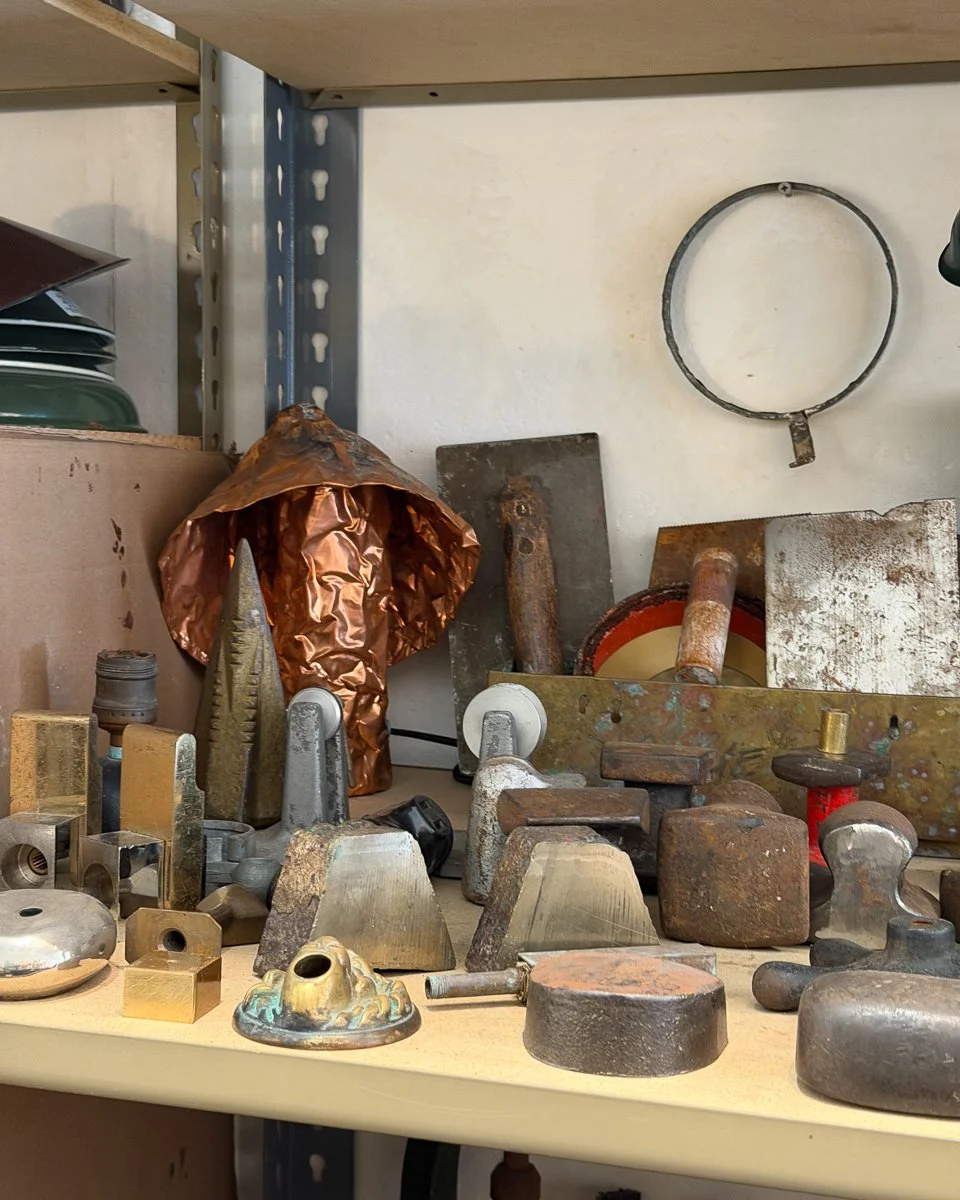
RD: That old things can be beautiful. Age brings beauty. You can’t recreate the wear on a tool used every day for decades. I like rescuing those objects and giving them another life. I collect little pencil nubs from job sites—I’m so curious about how someone keeps something for so long then decides to throw that thing away, but they’re beautiful. I’m drawn to metal because of the weight and the way it shows where it’s been touched—oils, patina, wear. I usually buy things that I find pretty first before I know the use. For example, I bought brass sheets 14 or 15 years ago before I knew what I’d do with them. I could barely afford them, but I loved the material. I’m still using that brass today.
People pay for new things that look aged, but the real thing is out there—you just have to dig.
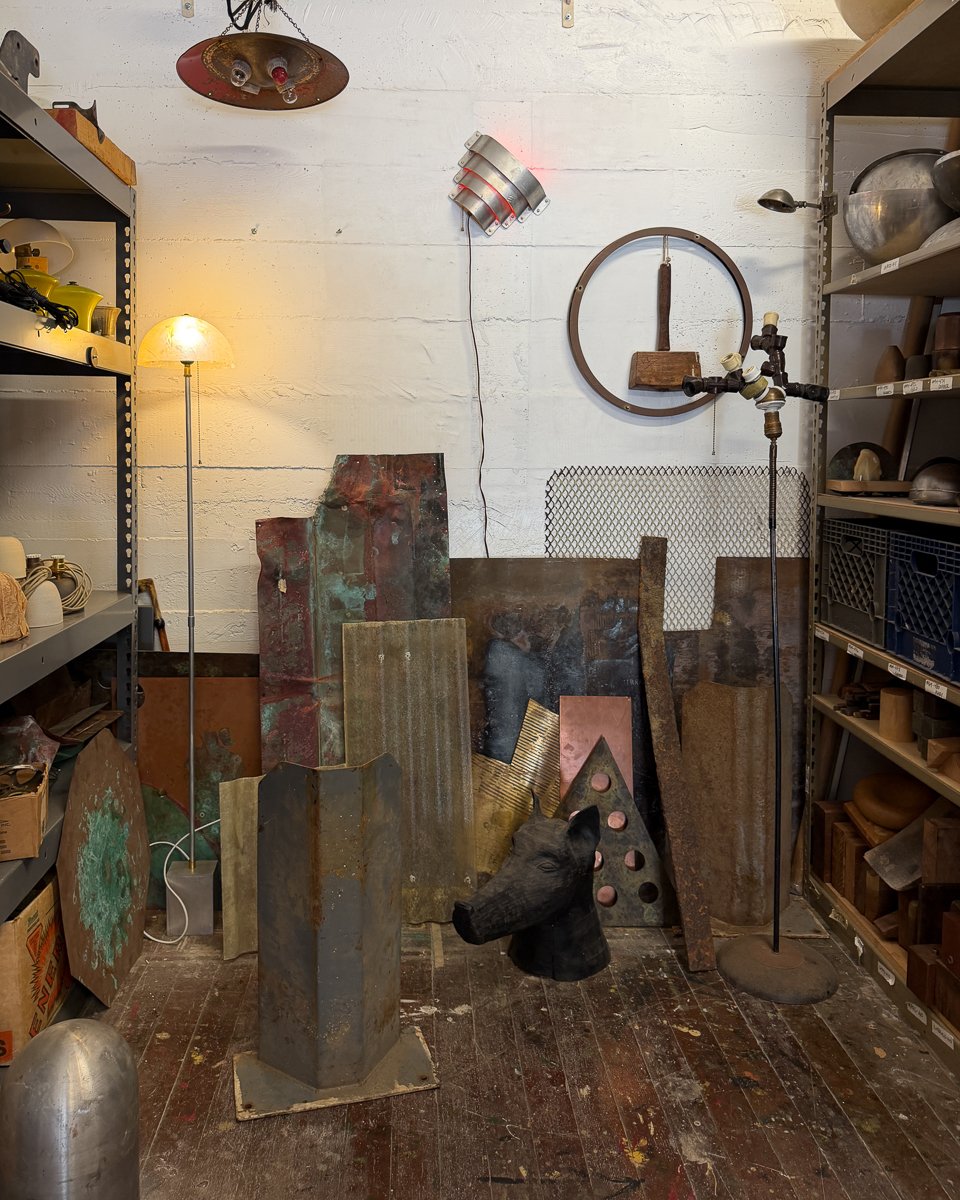
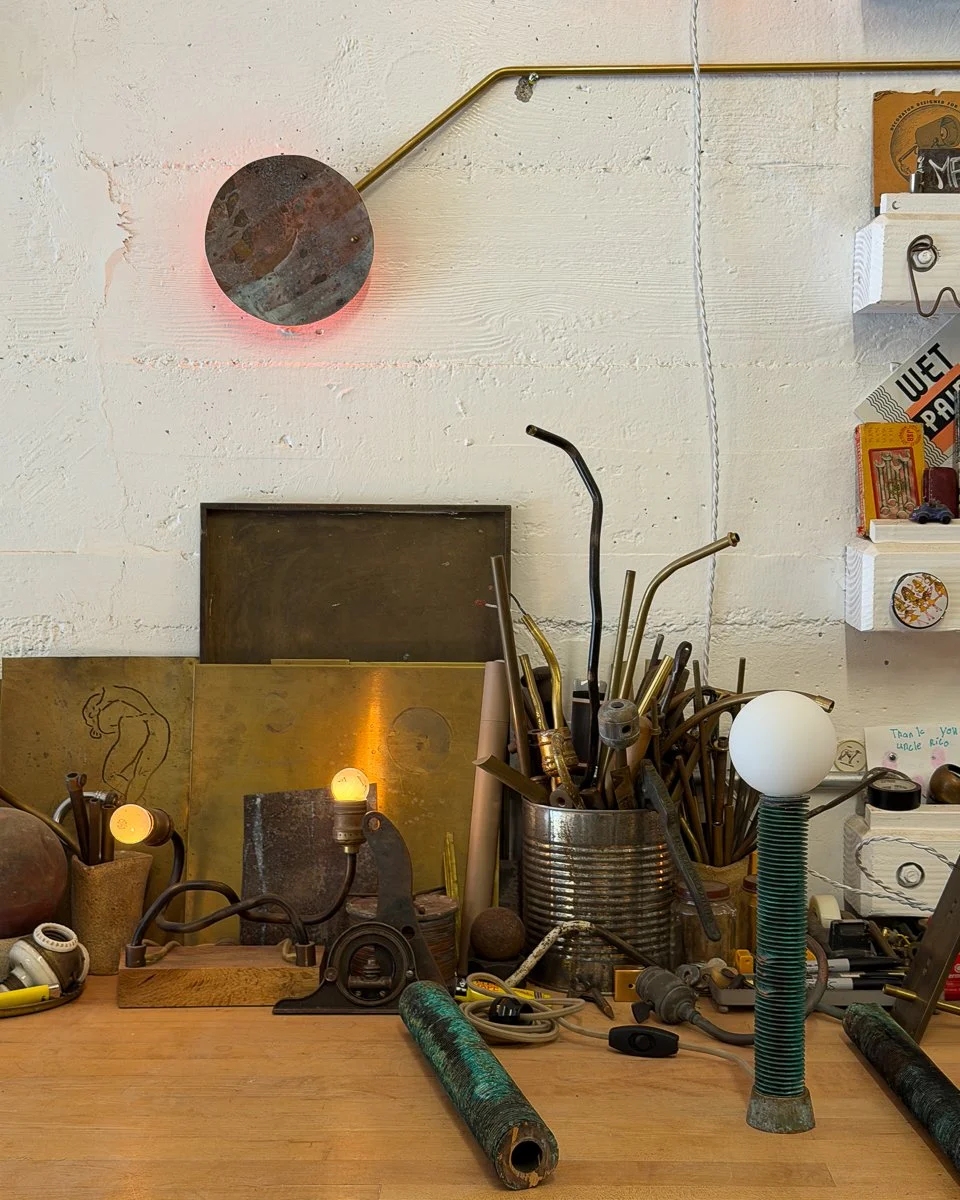
A collection of found objects and lighting in Duenas’ studio. Photo: Christine Lin
CL: How has your work evolved as your sense of self has evolved?
RD: It’s getting cleaner and more functional. Over time, skills get tighter. I’ve solved so many problems that each new piece runs into fewer problems. There’s more refinement in the details. I’m also trying to find language for why I make things. No one ever asked me before. Conversations like this help me articulate it.
CL: What’s something you’ve let go of creatively?
RD: That’s the nice part of having a day job - it gives me freedom. I can make whatever I want. If people like it, great. If not, that’s fine. Friends who are full-time artists sometimes feel stuck making commissioned work they’re not excited about. I don’t have that pressure. There’s a fear that if I relied on this financially, I’d lose some freedom.
There is not a lot of flexibility with union work; it’s very structured. It starts at seven sharp. I can’t choose to work three days instead of five. That’s my challenge of trying to do both. If I don’t work, I don’t get paid. But I’ve been with my company for nine years, and they respect what I do creatively. I’ve taken time off before shows to focus.
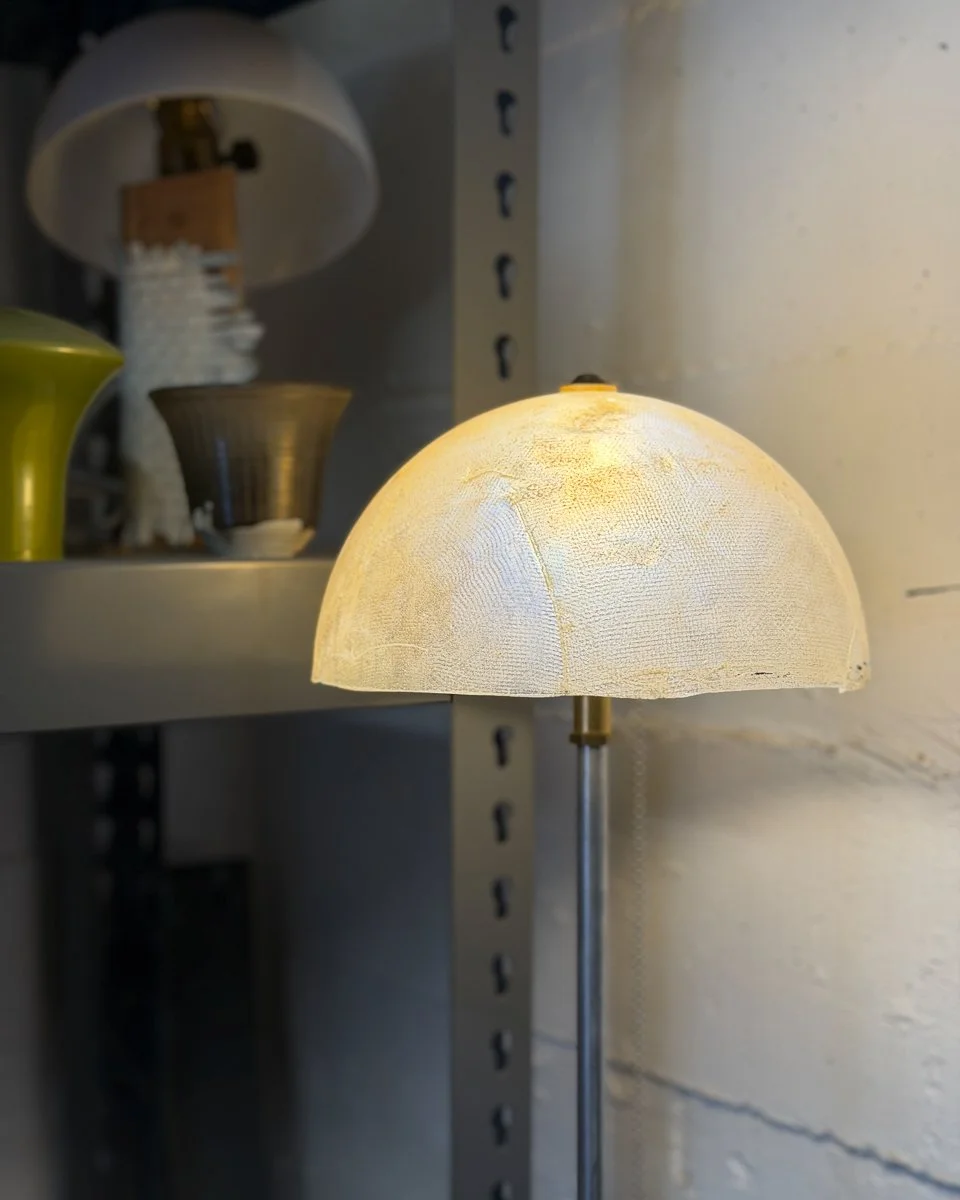
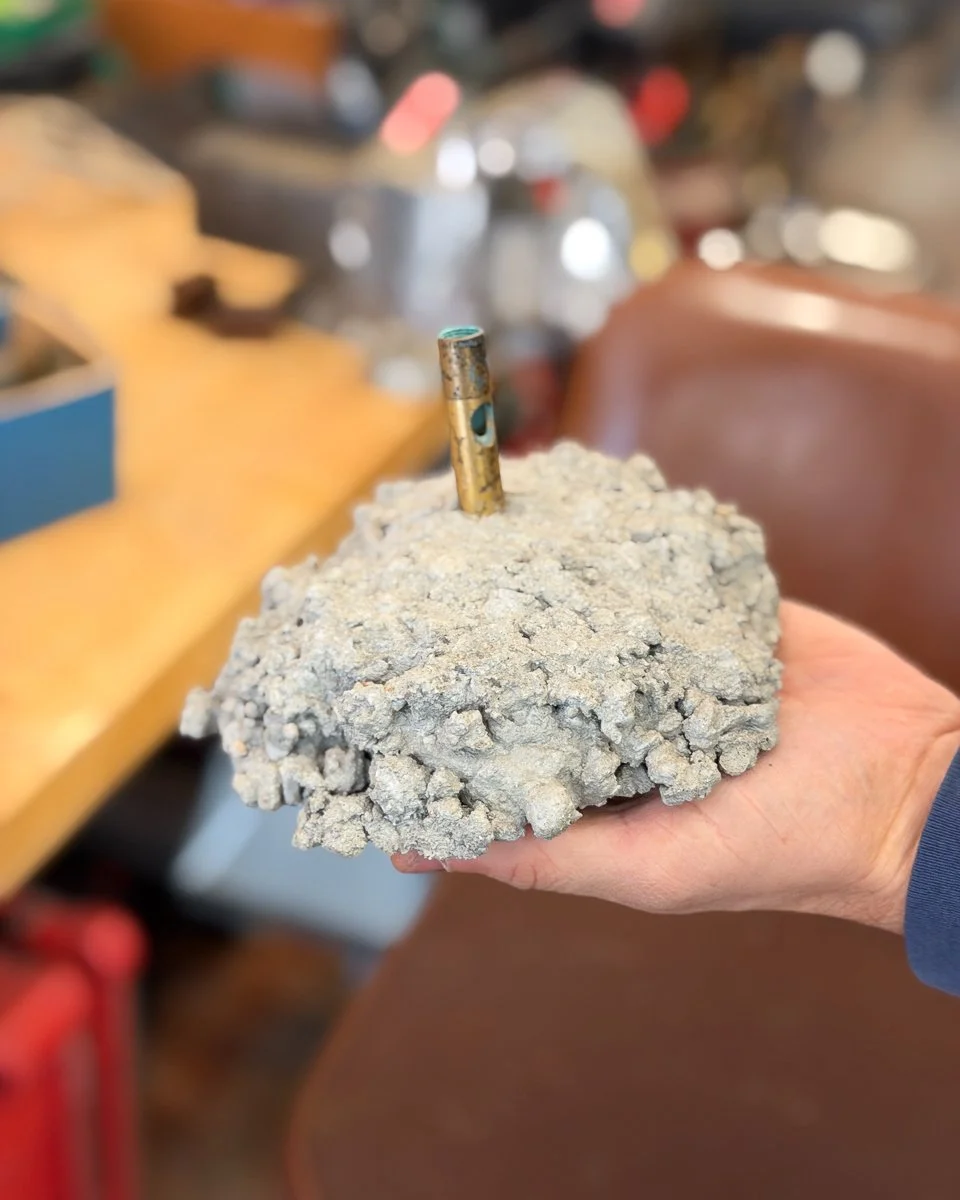
An experiment with a fiberglass shade. Photo: Christine Lin
CL: Where is your curiosity currently taking you?
RD: Fiberglass—it gives a warm glow. I’m using a woven fiberglass now but would like to explore the non woven sheets. I started playing with fiberglass because I found some old corrugated roofing made out of fiberglass that they no longer make. They now make that roofing out of plastic, of course.
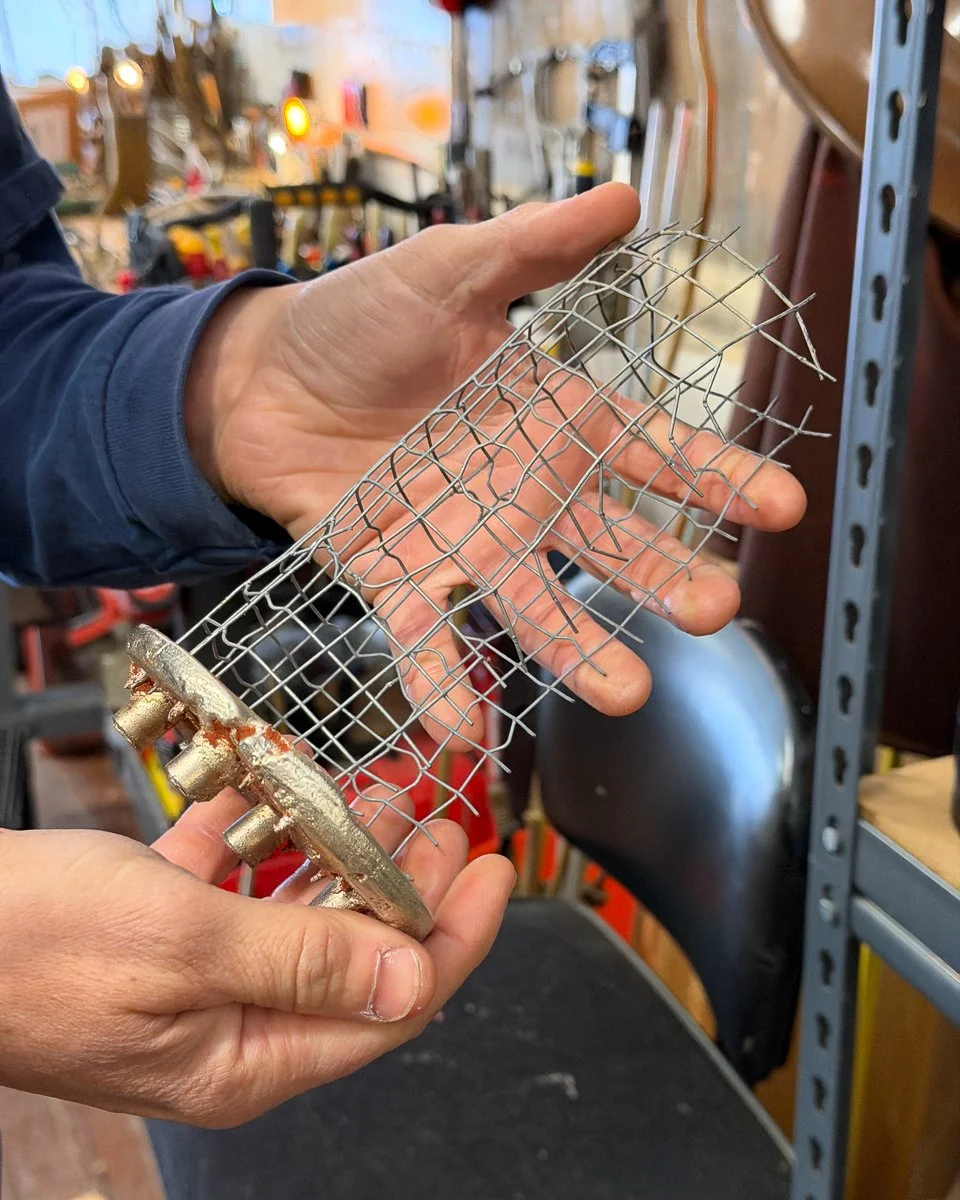
I’ve been experimenting with pewter casting. My friend Adam and I are doing a project where we each have to make a sconce, table lamp, and floor lamp incorporating a circle, square, and triangle, without discussing it beforehand, and using pewter. It’s just for play which we both talked about missing in our work.
Messing around with ceramics has also been fun. I’ve only been doing that for a couple years now. I did learn that I’m not into mass production. Making one object over and over again. Ceramics will always be one-offs. I don’t want to feel like a machine. Maybe someday I’ll design a light to manufacture at a lower price point, but even then, it would start with play.